MaxelTracker

MaxelTracker
Know exactly where your team's time goes. MaxelTracker gives managers clear, real-time visibility into team productivity — no spreadsheets, no guesswork. Built for businesses of every size.

Time management is the process of planning, organizing, and controlling time in order to improve efficiency, effectiveness, and productivity. The definition is simple and easy to understand but most people still fail at time management. McKinsey surveyed nearly 1,500 executives on how they spent their time and found only 9% called themselves "very satisfied" with their current allocation and about a third were actively dissatisfied.
In this blogpost, we will go beyond the basics of time management, learn how to protect your time in the modern world of distractions, and iterate your time management strategy from time to time to ensure you actually succeed at time management.
Time management is the process of consciously managing your time in order to make most out of the available time. It involves structuring your time, protecting your created schedule, and adapting your time management strategy to the realities.
Effective time management helps reduce time wastage, increase effective utilization of time, and improve productivity.
The most common reason people fail in time management is they do not follow the holistic approach. Either they build a great schedule and fail to protect it or build and protect a schedule but do not adapt to the evolving situations and realities.
Before learning how to structure your time, protect your schedule, and adapt your time management strategy, let’s understand why time management is hard in today’s time.

There are five distinct reasons time management is difficult: fragmented attention, task switching, falling attention time, not able to protect peak hours, and planning fallacy.
Modern workplaces are built to fragment attention: Microsoft's telemetry shows the average Microsoft 365 employee interrupted every two minutes by a meeting, email or notification, around 275 times a day. These constant interruptions make it difficult to focus because the average time to fully regain deep focus after a single disruption is around 23 minutes.
Switching between tasks is expensive: In 2009 Sophie Leroy found that when you move from one task to another, part of your attention stays behind with the first one. It happens most when tasks are left unfinished or when you're interrupted. An unstructured day where you are switching from one request to another does not let you focus your energy and attention on the one task, leaving you exhausted, drained, and unproductive.
Falling attention time: According to Dr. Gloria Mark (a professor of informatics at the University of California, Irvine), average focus time was about 2.5 minutes per screen before switching in 2003–2004. Now, it is 40–47 seconds in 2025-2026. Paired with interruptions, it makes it extremely difficult to protect your time schedule.
Not able to protect peak hours: In the modern day workplace, half of all meetings land between 9–11am and 1–3pm. This is precisely when circadian rhythms give most people their natural productivity peak. Not protecting your best hours leads to inefficient use of the time.
Poor time estimation: The planning fallacy (Kahneman and Tversky) says we systematically underestimate how long things will take, even when we've done the same task before and know better. This leads to poor estimates and subsequently poor time management.
“ Read more: What Are The 4 P’s in Time Management?
Effective time management directly translates into higher productivity, lower stress, improved work quality, and better work-life balance.
Higher productivity: Planning and prioritizing tasks helps you focus on high-value work, reduce distractions, and complete more in less time. By allocating specific time blocks to important activities, you minimize context switching and maintain momentum throughout the day.
Lower stress: Clear daily priorities and predictable timelines reduce last-minute rushes, anxiety, and burnout risk. Knowing exactly what needs to be done and when eliminates the mental load of juggling everything at once.
Improved work quality: Allocating adequate time for focused effort and revision produces quality work.
Better work-life balance: Effective time allocation creates clear boundaries between work and personal life, freeing time for family, hobbies, and self-care. When you finish work on schedule, you can fully disconnect and recharge.
To manage time at the workplace effectively, you need to structure your time, protect your schedule, and adapt your time management strategy.
Structuring your time is the first step where you audit how you currently spend time, create a list of tasks, and allocate the time among those tasks to create a schedule. It includes using various time management techniques like Eisenhower Matrix, task batching, and time blocking and tools like to-do list, calendar, and spreadsheet, to plan, organize, and schedule your time.
Protect is the second step where you try to protect your created schedule. Some people are great at creating a perfect schedule but not good at protecting it, which leads to poor execution of the time management plan. Especially, when you are in managerial roles where most of your time is spent managing people and answering supposed emergencies by email and phone. It is vital to build protection rituals into your schedule to defend your plan.
Adapt is the third aspect for time management where you revise your time management plan according to reality. You compare the planned vs actual and make iterations based on the real inputs rather than either abandoning the plan or clinging to it.
Here is step by step guide you can follow:
Create a simple log for every 30 minutes. Record activities you do in a 30-minute block. Include all the activities such as meetings, email & messages, admin work, deep work, breaks, and unplanned tasks.
Tracking does not need to be perfect to the exact minute. The goal is to capture the main activity for each block.
For example:
9:00–9:30: Team meeting
9:30–10:00: Email and Slack
10:00–10:30: Project report (deep work)
10:30–11:00: Unplanned call with client
11:00–11:30: Admin
Broadly divide the activities in 5-7 work categories for better organization.
Log how you spend time for one full week or two weeks if you need a better estimate.
It feels tedious and almost everyone wants to skip it, but it gives you a fair idea of where your time actually goes and identifies hidden time-wasters.
If it feels too much manual work, you can use automatic time tracking to create the detailed and accurate log.
Sort all the work activities, identify your main roles and responsibilities, and prioritize based on the importance.
Some activities are non-negotiable, fixed commitments, such as meetings and feedback sessions while others are flexible commitments, such as tasks, workshops, and personal skill development.
The ideal time management advice is to place these non-negotiable tasks on your calendar first and plan for the time left after subtracting fixed commitments to see your true available time.
But this approach fails for most professionals as the leftovers are too small. Research by Rob Cross found that most knowledge workers and leaders spend 85% or more of a given week on email, meetings and phone calls.
To get your time back for the deep and focused work, reconsider fixed commitments. Ask three questions: Does this still need to happen? Does it need to be this long? Does it need me?
Avoid unnecessary status meetings.
For the flexible commitments such as tasks, sort the tasks and define priority using a priority framework such as the Eisenhower Matrix.
For each priority task, estimate how long it will actually take based on your time audit rather than on optimism. Use your past data to avoid the planning fallacy and build realistic time buffers. You can use three point estimation to make a reliable and accurate estimate.
The three-point estimation method is a technique used to improve the accuracy of time or cost estimates by considering uncertainty and risk instead of relying on a single guess. Instead of asking "How long will this take?" and giving one number, you provide three estimates for each task :
Optimistic (O): The best-case scenario if everything goes perfectly. No delays, no problems, ideal conditions.
Most Likely (M): The realistic estimate under normal conditions, accounting for typical interruptions and minor issues.
Pessimistic (P): The worst-case scenario if significant problems occur
Gives the "Most Likely" estimate four times more weight, reflecting that it is the most probable outcome .
E= (O+4M+P) / 6
For example:
If you estimate a task as:
Optimistic: 4 hours
Most Likely: 6 hours
Pessimistic: 10 hours
Estimate: (4 + 4×6 + 10) / 6 = (4 + 24 + 10) / 6 = 6.3 hours
It helps account for uncertainty and reduce optimism bias.
“ Read more: Click here to learn more about creating a time budget.
Identify your peak energy windows, create focused blocks of time, and lock your most important tasks in the list there.
Start with 60–90 minute focus blocks. Give every block an end time.
Place the blocks into the calendar instead of a to-do list to create a visual schedule. Adjust time blocks based on your execution.
Leave 10–15 minutes between blocks for transitions, breaks, or overruns.
Plan only 60–70% of your available time so unexpected requests or delays do not collapse your entire schedule. It is because in the real workplace you must expect unplanned requests.
Turn off non-essential notifications during focus blocks, communicate your availability to colleagues, and decide in advance what truly counts as urgent so that every interruption does not feel like an emergency.
To make efficient use of the time and reduce context switching, group similar low-value tasks (email, calls, and admin) into dedicated time slots instead of scattering them throughout the day.
Evaluate progress at the end of each day. Compare your plan with what actually happened and adjust tomorrow’s schedule accordingly. Once a week, do a 15–30 minute review to assess progress toward your weekly outcomes and refine your time estimates to the existing realities.
Most of the professionals fill the data from the memory. This leads to inaccurate entries. For accurate entries, you can use automated time tracking tools that can help you with detailed tracking, such as apps and website tracking.
“ Read more: Top 10 Time Management Mistakes to Avoid for Better Productivity
Top time management techniques include Eisenhower matrix, time blocking, task batching, time boxing, pomodoro technique, eating the frog, and getting things done.
Eisenhower Matrix is a prioritization technique to sort tasks into four quadrants based on urgency and importance and for each quadrant it suggests what to do:
Quadrant 1: Do (urgent + important)
Quadrant 2: Schedule (important, not urgent)
Quadrant 3: Delegate (urgent, not important)
Quadrant 4: Eliminate (neither urgent, nor important).
This framework forces you to distinguish truly important work from merely loud or time-sensitive demands.
Time blocking is a scheduling method where you divide your workday into dedicated blocks of time on your calendar. Each block is assigned to a specific task or category of work. Instead of working from an open-ended to-do list and deciding reactively what to do next, you decide in advance when each piece of work will happen.
Task batching is a productivity technique where you group similar or cognitively related tasks together and complete them in a single, dedicated time block instead of scattering them throughout your day. This reduces context switching, maintains cognitive momentum, and completes similar work faster and more accurately.
Time boxing is a time-management technique where you assign a fixed, maximum amount of time (a box) to a specific task or activity in advance, and stop when the time is up, whether or not the task is finished. Unlike time blocking, which reserves calendar slots for categories of work, time boxing imposes a hard constraint on how long you are allowed to spend on a single task.
The Pomodoro Technique is a time-management method that breaks work into focused 25-minute intervals called "pomodoros," each followed by a short break. It includes creating a simple five-step cycle:
Choose a single task: Decide exactly what you'll work on before starting the timer.
Set a timer for 25 minutes: Work on that one task without interruption until the timer rings.
Take a 5-minute break: Step away from your work, stand up, stretch, get water, or look out a window.
Repeat: After the break, start another 25-minute pomodoro.
Longer break after four pomodoros: Once you complete four cycles, take a 15- to 30-minute rest before beginning the next set.
The "Eat the Frog" method is a productivity technique that instructs you to identify your most important, most dreaded, or most procrastinated-on task each day, your "frog". You complete it first thing in the morning before anything else. Tackling your biggest challenge early uses peak willpower, eliminates mental tension, and creates momentum for the rest of the day.
A comprehensive system for capturing, clarifying, organizing, and reviewing all your tasks and projects so nothing falls through the cracks. By externalizing commitments into a trusted system, you free mental space for focused execution rather than constant worry about forgetting something.
“ Read more: How to Track Time Spent on Tasks at Work: Guide for Managers?
Here are the biggest challenges in time management:
Procrastination and lack of prioritization: Delaying important tasks due to fear, perfectionism, or overwhelm creates a cycle of stress and last-minute rushes. Without clear priorities, all tasks feel equally urgent, leading to time spent on low-value activities while high-impact work stalls.
Constant digital distractions and interruptions: Non-stop notifications from emails, chat apps, and social media fragment attention and frequent interruptions from colleagues, unscheduled meetings, and urgent-but-unimportant requests disrupt deep work every few minutes and break concentration and momentum.
Unstructured workflows and poor time estimation: Starting the day without a concrete plan or to-do list invites reactive chaos instead of proactive progress. Misjudging how long tasks take leads to overpacked schedules, missed deadlines, and cascading delays.
Here are the main categories of time management tools and how they can help:
Task and project management apps: These tools let you capture, organize, and prioritize tasks and projects in one place, often with features like due dates, labels, subtasks, and progress tracking.
Calendar and scheduling tools: Digital calendars help you visualize your day, week, or month and assign specific time slots to meetings, focus blocks, and personal commitments.
Time tracking and awareness apps: These tools log how much time you spend on different tasks, projects, apps, or websites, either manually or automatically.
Focus and distraction-blocking tools: Website and app blockers, as well as focus timers, restrict access to distracting content and enforce structured work/break intervals.
Habit and routine trackers: Habit apps help you build and maintain daily routines, such as morning planning, exercise, or end-of-day reviews, through reminders, streaks, and gamification.
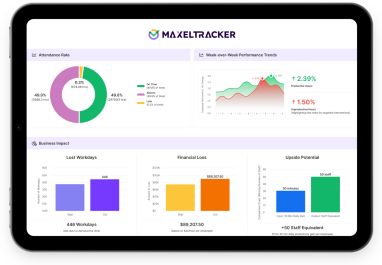
MaxelTracker is a productivity tracking platform that helps users track, understand, and analyze how they spend time. It tracks the time spent across work activities, provides a breakup into useful metrics such as productive, non-productive, and neutral hours, and creates a detailed log of app and website usage. This gives you a detailed insight into your time.
To learn more about how MaxelTracker can help, you can connect with one of our experts or try the tool for free.

1. What is the 3-3-3 rule for time management?
The 3-3-3 rule, popularized by author Oliver Burkeman, structures your workday into three simple categories:
3 hours of deep, focused work on your single most important project.
3 shorter, urgent tasks that need to be done today (e.g., emails, calls, quick admin).
3 maintenance activities that keep your work and life running smoothly (e.g., organizing your workspace, updating systems, exercise).
This method limits your daily to-do list to nine pre-decided items, reducing overwhelm while ensuring strategic progress
2. What are 5 key elements of effective time management?
The five key elements of effective time management are goal setting, prioritizing, planning, focusing, and delegating.
Goal setting:: Define clear, measurable goals so your time is directed toward meaningful outcomes.
Prioritization: Identify and focus on the few tasks that drive the most impact, using tools like the Eisenhower Matrix or Pareto Principle.
Planning: Schedule your day in advance, allocating specific time blocks for high-priority work before meetings and distractions fill your calendar.
Focus protection: Minimize interruptions by turning off notifications, batching communication, and defending dedicated deep-work periods.
Elimination: Say "no" to low-value tasks and commitments that do not align with your key goals.
3. What are the top time management skills?
Here are the best time management skills to learn:
Prioritization: The ability to identify which tasks deserve attention first based on importance, urgency, and impact.
Planning and scheduling: Mapping work across realistic time periods, such as daily, weekly, or project-based, helps break larger goals into manageable steps and prevents reactive chaos.
Focus management: The ability to direct sustained attention toward one task for a meaningful period without distraction.
Delegation: Identifying tasks that others can handle frees your capacity for higher-leverage work that requires your unique skills.
Time estimation: Tracking how long tasks actually take improves your ability to plan realistically and avoid overpacked schedules.
4. What are top time management books to read?
Here are some of the top time management and productivity books worth reading:
Getting Things Done by David Allen
Atomic Habits by James Clear
Deep Work by Cal Newport
The ONE Thing by Gary Keller and Jay Papasan
Eat That Frog! by Brian Tracy
Four Thousand Weeks by Oliver Burkeman
Make Time by Jake Knapp and John Zeratsky
Related Blogs
Top AI-based Employee Monitoring Tools
As remote and hybrid work becomes the norm, employers face challenges in tracking employee productivity and accountability. AI-powered employee monitoring tools have stepped in to help, offering features like time management and productivity insights.

Employee Monitoring Software vs Data leak Prevention (DLP): Which is Better for You?
As businesses evolve, balancing security with productivity has become a top priority—especially in an era where hybrid and remote work are the norm. Organizations must protect sensitive data while also ensuring employees remain engaged and efficient.
What is Employee Monitoring Software and How Does It Work?
Employee monitoring software helps track various aspects of your employees' activities, including working hours, location, and computer usage. It’s beneficial for managing office-based, remote, or hybrid workplaces.